
Chhattisgarh's connectivity changing with railway network expansion, industrial development to get new momentum
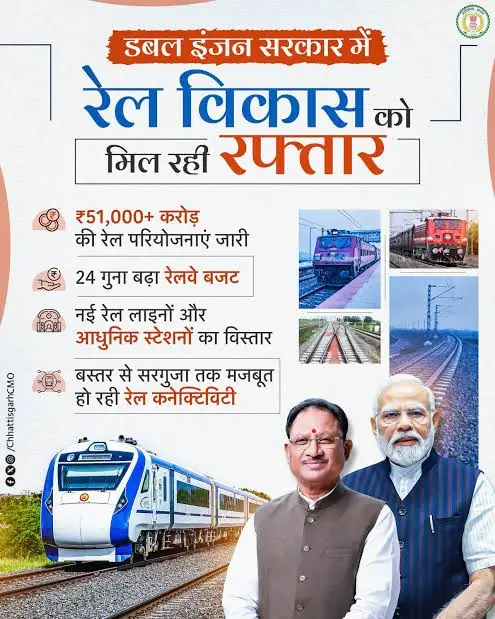
Industrial development to get new momentum. Work is underway on railway projects worth Rs 51,080 crore in the state. New rail corridors will accelerate freight transportation, industrial connectivity and development of tribal areas. By Dhananjay Rathore Joint Director, Public Relations Directorate, Raipur Special Article Raipur, Basic railway infrastructure is rapidly developing in Chhattisgarh, benefiting every region and every citizen of the state. The development of railway stations equipped with modern facilities will provide passengers with a safer, smoother and more convenient travel experience. Common citizens will get quality rail services with better waiting rooms, facilities for the disabled, clean premises, modern passenger amenities, and advanced infrastructure. Chhattisgarh, one of the country's major industrial and mineral producing states, is now connecting its railway network expansion to the needs of national logistics and regional connectivity. Currently, railway projects worth Rs 51,080 crore are underway in the state. Chhattisgarh is an important industrial and logistics hub in Central India. In such a scenario, a strong railway network will give new momentum to the state's economy. Railway development will reduce transportation costs for industries, encourage investment, strengthen the energy sector, provide better markets for farmers, and create new opportunities for employment and entrepreneurship for the youth. Chief Minister Mr. Vishnu Deo Sai said that under the leadership of the double-engine government, railway infrastructure is undergoing unprecedented expansion in Chhattisgarh. Development is getting a new direction with new railway projects, doubling, electrification, and expansion of modern railway facilities in the state. This transformation will further strengthen the resolve to build a developed Chhattisgarh. With the coordinated efforts of the central and state governments, emphasis is being placed on expanding railway infrastructure in Chhattisgarh. The central government has increased the state's railway budget allocation for the financial year 2026-27 to Rs 7,470 crore, compared to an average of Rs 311 crore annually during 2009-14. This is an increase of about 24 times in the average annual allocation. The main objective of this investment is to reduce pressure on busy railway routes, increase the movement of mineral and industrial goods, and extend rail connectivity to areas where connectivity has been limited so far. National freight transportation will get an alternative rail route. The Kharasia-Naya Raipur-Paramlalkasa rail corridor is important in Chhattisgarh's rail strategy. This approximately 278-kilometer-long route was approved by the Union Cabinet in April 2025. At that time, the project cost was estimated at Rs 8,741 crore. Later, it was revised, and its estimated cost was reduced to Rs 7,854 crore. The objective of this project is to lay additional railway lines for freight and passenger trains by bypassing the busy rail sections of Bilaspur, Raipur, and Durg. This corridor is planned to reduce operational pressure on the Kolkata-Mumbai rail route and provide better rail connectivity to new industrial areas, including Balodabazar. This will increase the freight transportation capacity for industries related to coal, iron ore, steel, cement, and power generation and help reduce dependence on road transport. Also, smoother movement of freight trains will help industrial units easily reach markets and ports. Baster's connectivity will be strengthened. Another important aspect of railway network expansion is Baster's connectivity. Land acquisition for the important rail line from Raoghat to Jagdalpur (140 km) has been completed. Surveys for the new rail line projects of Kirandul-Kottagudem (180 km) and Garhchiroli-Bijapur-Kirandul (Bacheli) totaling 490 kilometers are in progress. Under the Dalli Rajhara-Raoghat rail project, rail services have started from Dalli Rajhara to Antagarh (77 km). With the commencement of passenger rail services on this section, thousands of villagers have been connected to the rail network for the first time. The next phase of this project involves developing connectivity to Raoghat. Upon completion of the project, the iron ore mines of Raoghat will be directly connected to the Bhilai Steel Plant, which will provide new strength to both industries and the local economy. Meanwhile, the doubling of the Kottavalasa-Kirandul rail line has significantly increased the capacity for freight and passenger transportation in the Baster region. Plan for a new connection from Katghora to Dongargarh. The proposed Katghora-Dongargarh rail line is approximately 295 kilometers long. This route is proposed from Katghora via Kartala, Mungeli, Kawardha, and Khairagarh to Dongargarh. The project is planned to be developed through a joint venture between the Ministry of Railways and the Chhattisgarh government. A proposal has been made to form a Special Purpose Vehicle (SPV) for this. The importance of this rail line lies in connecting areas without or with limited rail facilities to the rail network. This is expected to boost passenger movement, transportation of agricultural produce, trade, and tourism. New projects for North Chhattisgarh as well. Rail corridors from Sargaida-Pathalgaon-Ambikapur (244 km), Dharamjaigarh-Pathalgaon-Lohardaga (301 km), and Ambikapur-Barwadih (200 km) are also likely to be approved soon by the Ministry of Railways. The issue of expediting decisions and survey processes on these proposals was raised in August 2026. These projects will strengthen rail connectivity in North Chhattisgarh and border areas, creating new opportunities for trade, tourism, mineral transport, and local employment. Modernization of stations Along with new rail lines, work is also being done to modernize the existing network and stations in Chhattisgarh. According to the state government, under the Amrit Bharat Station Scheme, 32 railway stations in Chhattisgarh are being developed at a cost of approximately Rs 1,680 crore. The objective of these projects is to improve passenger facilities and make station premises more organized. Under the leadership of Prime Minister Mr. Narendra Modi, railway infrastructure is undergoing extensive modernization in the country, and Chhattisgarh is also directly benefiting from it. The virtual inauguration of Champa, Balod, and Sarona railway stations in Chhattisgarh under the Amrit Bharat Station Scheme by Prime Minister Mr. Narendra Modi is a significant achievement in the direction of railway development in the state. Chief Minister Mr. Vishnu Deo Sai has expressed his gratitude to Prime Minister Mr. Narendra Modi and Union Railway Minister Mr. Ashwini Vaishnav for this public welfare initiative. Chief Minister Mr. Vishnu Deo Sai said that railways are not just a means of transportation but a strong foundation for economic and social development. The upgrading of important stations like Champa, Balod, and Sarona will give new momentum to trade, tourism, the local economy, and regional development. This will make commuting more convenient for people and also promote employment and economic activities.