
Benefit of government schemes reaching the last person in society: Governor Shri Raman Deka
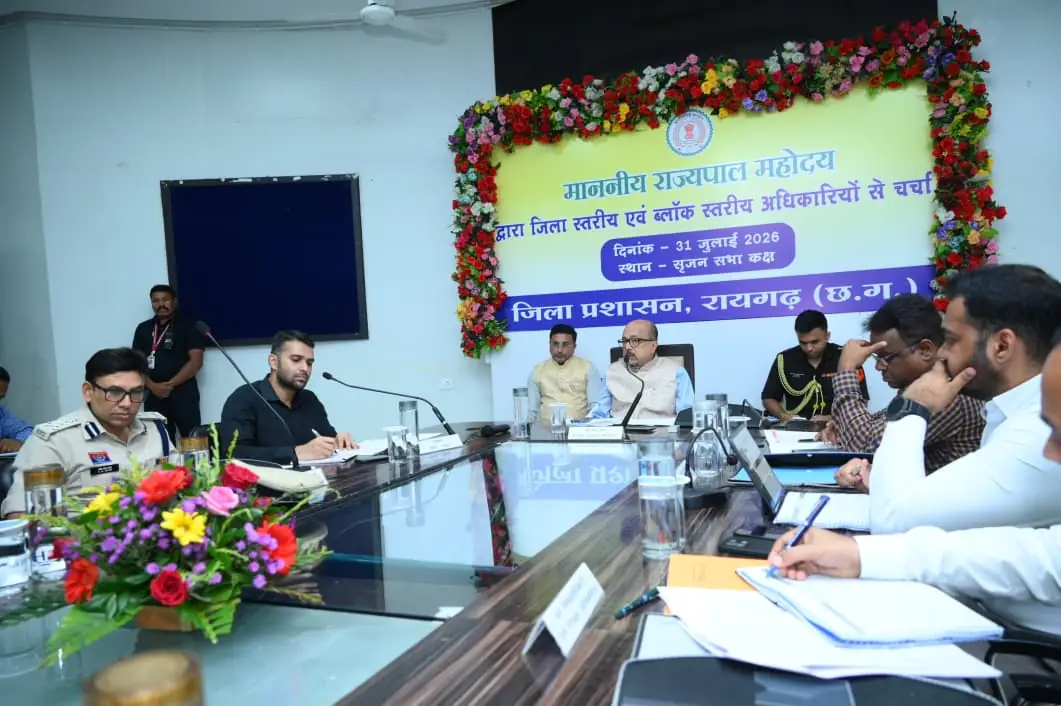
Governor Shri Raman Deka emphasized that the benefit of government schemes must reach the last person in society. He highlighted water conservation, environment, organic farming, education, health, livelihood and good governance with special focus. He gave instructions to ensure effective implementation of schemes with seriousness, accountability and coordination. Governor discussed with district and development block level officials in Raigarh. Raipur, the state's Governor Shri Raman Deka, on the first day of his two‑day Raigarh visit, met district and development block officials to review progress of various welfare schemes and programs. In a meeting at the District Collectorate, he discussed over twenty points including water conservation, plantation, environmental enhancement, organic agriculture, sanitation, yoga, TB eradication, livelihood, cooperatives and road safety, directing officials to work with full seriousness, sensitivity and accountability. He stated that the real purpose of government schemes will be fulfilled only when their benefits reach the last person in society, urging inter‑departmental coordination and prioritising public interest. Present were the Governor's secretary Dr. C.R. Prasanna, Collector Mr. Mayank Chaturvedi and Senior Police Superintendent Mr. Shashimohan Singh. He stressed making water conservation a mass movement, noting that preserving every drop of rainwater is a critical need. He referred to water conservation efforts in Assam, Tripura and Chhattisgarh's Bemetara district, directing a wide awareness campaign for rainwater harvesting, water harvesting and source protection, and emphasizing the preservation and rejuvenation of old wells, stepwells and traditional water sources with community participation to achieve sustainable groundwater improvement. He instructed linking the "One Tree in Mother’s Name" campaign with public participation, encouraging each citizen to plant at least one tree, especially in Amrit Sarovar complexes, and ensuring extensive plantation in schools, colleges and public areas. He reported that industrial units are providing 10,000 saplings to be distributed to the public. He directed preparing an integrated plan for soil‑appropriate plantation and water conservation with community involvement. He promoted organic farming, reducing dependence on chemical fertilizers by encouraging bio‑fertilizers, compost, green manure, mother culture and blue‑green technologies, and supporting various organic and medicinal crops. He urged large farmers to adopt dairy and fishery alongside agriculture for additional income, and emphasized crop diversification with pulses, oilseeds and other profitable crops. He reviewed the Swachh Bharat Mission, emphasizing regular cleaning, better maintenance and usability of public toilets, and discouraging non‑recyclable plastics to protect land and environment. He called for yoga to become part of daily life, directing regular yoga camps in schools, hostels, colleges and institutions and encouraging citizens to incorporate yoga into their routines. He reviewed TB eradication efforts, directing effective action to meet targets, and emphasized education, health, agriculture and livelihood programs for the upliftment of scheduled tribes, urging officials to act with sensitivity and seriousness. He noted that all service centres are active and that weekly assistance is provided to villagers for government services and applications, with volunteers appointed. He praised the Nalanda Library initiative for youth, announcing its establishment in remote development blocks such as Dharamjaygarh, Tamnar, Gharghoda and Lailunga to provide better study facilities. He directed linking women to self‑employment and income‑generating activities under the National Rural Livelihood Mission, emphasizing women’s empowerment as a foundation of rural development. He discussed de‑addiction, urging community awareness, and instructed the Cooperative Department to form new committees in each gram panchayat, and to enforce helmet use for two‑wheelers and control heavy vehicle movement near schools for student safety. He emphasized strengthening the Indian Red Cross Society by increasing membership and connecting more people, and highlighted NCC activities to develop discipline, service spirit and nation‑building among youth. The meeting concluded with a souvenir presented to Governor Raman Deka. District and development block officials were present.