

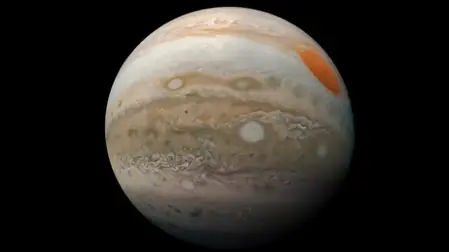
Imagine a storm twice Earth’s size raging for centuries—that’s Jupiter’s Great Red Spot, a ruby-red maelstrom that’s been swirling since at least the 17th century. As the solar system’s behemoth, Jupiter hosts this anticyclonic beast, which recent missions are finally demystifying.
NASA’s Juno probe, launched to decode gas giant secrets, captured breathtaking 2018 imagery enhancing the spot’s vivid hues. It exposed roots extending 350 kilometers down, dwarfing neighboring storms at a mere 100 km. Juno’s solar sails propel it through elliptical orbits, scanning Jupiter’s core and evolution.
Complementing this, Hubble’s time-lapse sequences depict the GRS oscillating unpredictably. Every three months, it pulses—broadening during slowdowns, slimming during speed-ups. Researcher Amy Simon highlighted this ‘jelly-like’ motion as a surprise, with no hydrodynamic model yet explaining it.
In UV light, the storm’s heart glows brightest when fullest, signaling thinner atmospheric haze. Subtle daily shifts in its crimson tones and fury hint at complex interactions. These insights bridge Jovian chaos to terrestrial tempests and distant exoworld climates, promising revolutions in planetary science.