

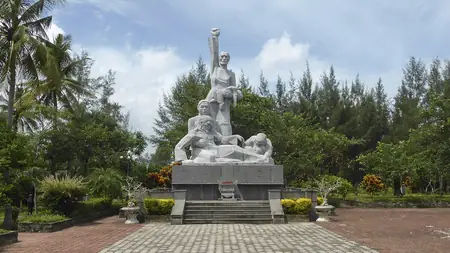
March 16, 1968, dawned like any other in the embattled village of My Lai, South Vietnam. But for its residents, it became a day of unimaginable terror as U.S. Army’s Charlie Company descended, convinced Viet Cong lurked nearby. Under Lt. William Calley’s command, the operation morphed into one of history’s most infamous war crimes.
Expecting fierce combat, soldiers encountered only civilians: mothers cradling babies, elderly men tending rice fields. Undeterred, they rounded up villagers, herded them into clusters, and opened fire. Houses burned as cries echoed through the hamlets of My Lai and nearby areas.
Detailed probes revealed the scale: 504 dead, mostly women and children, their bodies mutilated and discarded in mass graves. Rape, torture, and summary executions defined the rampage, lasting hours.
Warrant Officer Hugh Thompson, overhead in his chopper, witnessed the carnage and intervened heroically, airlifting survivors and confronting his comrades at gunpoint. His actions preserved a sliver of humanity amid the abyss.
The truth trickled out despite military whitewashing. By November 1969, Seymour Hersh’s reporting unleashed a firestorm, fueling Vietnam War opposition and eroding support at home. Courts-martial ensued, but only Calley faced real punishment—a brief stint behind bars after a commuted life term.
My Lai’s legacy endures, etched in memorials and military doctrine reforms like the Rules of Engagement. It compelled America to confront its demons, highlighting how fear and orders can unleash monstrosity.