

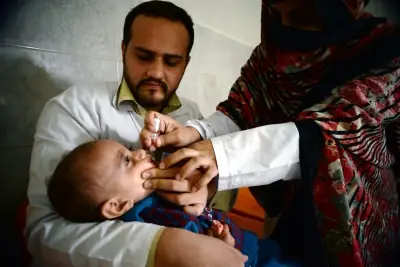
A shadow fell over Pakistan’s polio eradication efforts as the first wild poliovirus infection of 2026 was detected in a young child from Sindh. The four-year-old from Sujawal’s Bello Union Council has ignited concerns about the disease’s stubborn persistence in the region.
Verified by NIH Islamabad and the polio reference lab, this case was announced by NEOC, according to Dawn newspaper. It’s a troubling start to the year for a nation still endemic for polio alongside Afghanistan.
Attacks on vaccination teams in volatile areas like Khyber Pakhtunkhwa and Balochistan continue to undermine progress. The latest campaign vaccinated 44.3 million children with impressive 98% coverage, but 950,000 slipped through the cracks—mostly because they weren’t home.
Guest vaccinations reached 2.5 million, offering some compensation. Yet, 233,000 remained out of reach due to security woes, boycotts, and snow-blocked paths. Khyber Pakhtunkhwa bore the brunt with 184,000 misses, plus 50,000 in occupied territories.
Balochistan halted drives in high-risk districts like Mastung and Gwadar. Refusals hit 53,000 nationwide, with Karachi’s 31,000 forming the largest cluster at 58%. The first 2026 round saw one million unvaccinated and widespread hesitancy.
Successes include Punjab’s 22.9 million, Sindh’s 10.5 million, Khyber Pakhtunkhwa’s 7.13 million, and Balochistan’s 2.3 million doses. Capital and occupied areas also saw substantial numbers: 455,000 in Islamabad, 261,000 in PoGB, and 673,000 in PoJK.
This detection demands urgent action. With coverage so near-perfect on paper, the remaining gaps are unforgivable in a country of Pakistan’s scale. Eradicating polio requires not just drops, but conquering fear, terrain, and resistance to safeguard every child.