

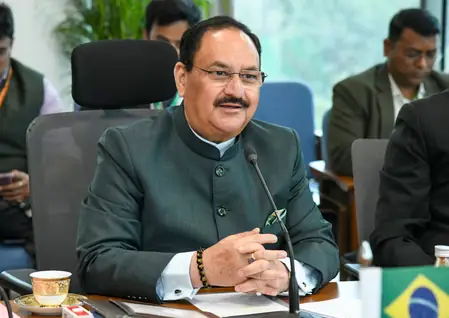
In a bold vision for industrial growth, India aims to elevate its chemical sector to new heights, projecting a global share of 5-6% by 2030 and a monumental $1 trillion turnover by 2040. Speaking at a key post-budget event, Union Minister JP Nadda outlined the roadmap that’s set to transform the industry.
Central to this strategy is a Rs 13,000 crore budgetary boost for the Bio-Pharma Power Scheme and three specialized chemical parks. These moves are strategic bets on India’s capacity to lead in high-value segments like biologics.
The global pharma landscape is evolving rapidly. By 2035, biologics will constitute 40% of medicines worldwide, fueled by $300 billion in patent cliffs by 2030. India’s BioPharma Mission, with Rs 10,000 crore allocated over five years, equips the nation to seize this moment.
Securing even a modest 1% slice of the biosimilars market could generate Rs 2 lakh crore in yearly revenue. To make it happen, Nadda called for strengthening NIPER-like institutions and expanding to 1,000 clinical trial sites, fostering a talent pipeline and innovation ecosystem.
Streamlining regulations is crucial. The CDSCO will be fortified to expedite approvals for biosimilars and fermentation technologies. India’s current output stands at Rs 19.4 lakh crore, with strengths in dyes and agrochemicals, yet global share lingers at 3% due to infrastructural shortcomings.
Addressing this head-on, Rs 3,300 crore will develop three state-of-the-art chemical parks. Equipped with seamless utilities, cutting-edge effluent treatment, logistics integration, and top-tier safety, these parks promise 20-40% cost savings via collaborations and inherent circular economy designs.
As India invests in these pillars, the chemical sector is poised for exponential growth, cementing its role as a global powerhouse.