

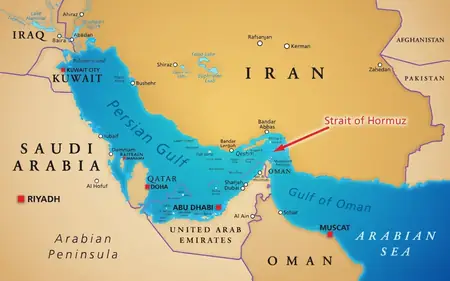
The Middle East teeters on the brink after devastating U.S. and Israeli attacks on Iran, met with fierce Iranian counterstrikes via drones and missiles against Israel and American bases in Bahrain, Kuwait, and Qatar. With hostilities boiling over, the spotlight falls on the Strait of Hormuz, where oil tanker movements have all but frozen.
This strategic 33-kilometer-wide passage at its slimmest connects Iran’s Persian Gulf to Oman’s Gulf and the Arabian Sea beyond. Designated shipping lanes for tankers are razor-thin at 3 kilometers each side. Classified as international waters despite overlapping territorial claims, it buzzes with commerce near the UAE’s bustling ports.
Iran’s warnings post-attacks have cleared the strait of new entrants, though a few vessels slipped out. A mysterious assault on a sanctioned tanker off Oman underscores the peril, stoking global energy jitters.
Historically, the strait channeled ancient Silk Road goods eastward and westward. In the modern era, it funnels colossal volumes: Saudi, Iranian, Iraqi, Kuwaiti, Qatari, Bahraini, and Emirati crude and LNG head primarily to Asia, especially China.
Daily throughput exceeds 20 million barrels of oil—20% of world supply—plus Qatar’s dominant LNG shipments. Pipelines offer limited Saudi-UAE bypasses, but the strait’s dominance is unchallenged for bulk flows.
Blockage risks explosive price surges in oil and gas, rippling through fuel pumps and economies worldwide, with Asia bearing the brunt. Past crises abound: 1973 embargo, 1980s tanker skirmishes, 2012 threats, 2019 blasts, and seizures.
Bahrain-based U.S. Fifth Fleet patrols ensure passage in peacetime, but war changes everything. Even brief shutdowns spell chaos: premium insurance, supply shocks, and economic pain for energy-hungry Asia.
In this powder keg of Iran-US-Israel strife, the Strait of Hormuz isn’t just a sea lane—it’s the global energy lifeline hanging by a thread.