

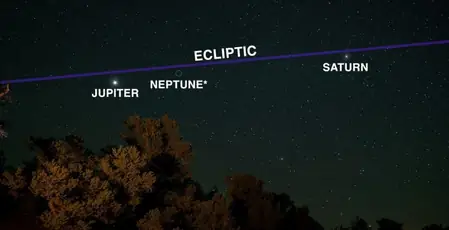
The heavens occasionally treat us to a rare treat: planets marching in unison across the sky like soldiers on parade. Dubbed ‘Planet Parade,’ this phenomenon draws stargazers outdoors, binoculars in hand, eager for a glimpse of the solar system’s synchronized splendor.
Scientifically, it’s no true alignment but an optical illusion born from our shared orbital plane. Planets trace the ecliptic, a celestial highway that stretches linearly from Earth. During favorable positions—conjunctions bunching planets together or oppositions placing them boldly against the dark—they queue up dramatically.
Spot the big five with ease: Mercury’s quicksilver flash, Venus’s brilliant beacon, Mars’s ruddy glow, Jupiter’s steady shine, and Saturn’s golden hue. These ‘wandering stars’ shift positions nightly, unlike fixed constellations, a trait noted by ancient astronomers. Dimmer duo Uranus and Neptune demand optical aid.
NASA highlights multi-planet displays enduring days on end, sometimes spanning months as slower orbits keep the lineup stable. Prime viewing slots? Twilight hours post-sunset or pre-dawn, with planets elevated to evade atmospheric blur. Scout apps or charts pinpoint exact timings; steer clear of urban glow and low horizons.
Rarity amps the thrill—Mercury and Venus, solar sidekicks, fleetingly join the outer trio. Venus lingers as the evening or morning star for stretches, Mercury darts in briefly. Their convergence crafts unforgettable scenes, evolving gradually over time.
Beyond beauty, Planet Parades demystify our cosmic home, bridging ancient sky lore with modern science. As planets slowly shift, so does the parade, rewarding patient observers with a profound sense of scale and serenity in the vast night.