

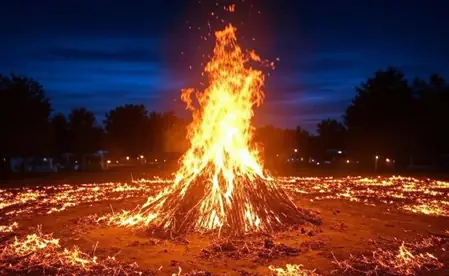
As Holi approaches, preparations for Holika dahan grip the nation, but in Saharanpur’s Barsai village, the bonfire ritual is conspicuously absent. Instead, residents head to nearby areas for the ceremony, reserving their village for the riot of colors that defines Holi’s second day.
At the heart of this practice is the extraordinary west-facing Shivling in the local temple, said to be Svayambhu—self-formed. Folklore recounts that Kauravas constructed the temple millennia ago, only for Bhima to alter its orientation during the Mahabharata battle by jamming his gada into the door and rotating it westward.
This directional anomaly makes the lingam uniquely sacred. Villagers revere it so deeply that they fear Holika’s flames might harm Shiva’s feet, a taboo unbroken for 5,000 years. The custom isn’t mere superstition; it’s woven into the fabric of cultural and historical identity.
Barsai’s lore extends to Krishna, who visited after the war and blessed the land, likening it to his Braj homeland—hence the name ‘Barsai,’ evoking welcome and purity.
Holi in Barsai is a spectacle of unity and joy. From dawn, groups roam with pichkaris, smearing gulal, exchanging prasad, and feasting on homemade delicacies. This blend of restraint and revelry highlights India’s diverse festival tapestry.