

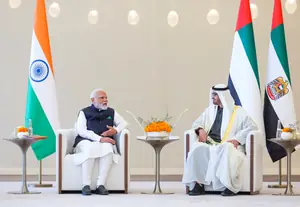
Prime Minister Narendra Modi reached out to UAE President Mohamed bin Zayed Al Nahyan over phone on Sunday, delivering a firm condemnation of the deadly assaults on UAE territory. Amid rising regional instability, Modi affirmed India’s unwavering solidarity with its Gulf ally during this challenging phase.
Taking to social media platform X, the Prime Minister shared, ‘Had a call with UAE President and brother Sheikh Mohamed bin Zayed Al Nahyan. Condemned the attacks on UAE, mourned the casualties, and thanked them for caring for our Indian community. India supports reducing tensions for peace and stability in the region.’
The gesture highlights the deep-seated India-UAE bonhomie, built on robust economic exchanges, energy security, military collaboration, anti-terror initiatives, and the welfare of millions of Indian workers in UAE. This expatriate population serves as a vital bridge, enhancing mutual understanding and cooperation.
Shortly after, PM Modi convened an emergency Cabinet Committee on Security meeting in New Delhi. Triggered by the deteriorating situation in West Asia—marked by US-Israel strikes on Iran and unconfirmed reports of Iranian leader Ali Khamenei’s death—the huddle aimed to calibrate India’s response.
The high-stakes gathering featured top brass: Rajnath Singh (Defence), Amit Shah (Home), S. Jaishankar (External Affairs), Nirmala Sitharaman (Finance), Ajit Doval (NSA), and Vikram Misri (Foreign Secretary). Returning from southern and western state visits, Modi dove straight into the security review upon arrival.
The CCS, comprising the Prime Minister and key ministers, remains the nerve center for India’s defense and foreign policy formulations. As Middle East flashpoints threaten global energy markets and migration flows, India’s dual track of reassurance to allies and internal preparedness signals strategic foresight.