

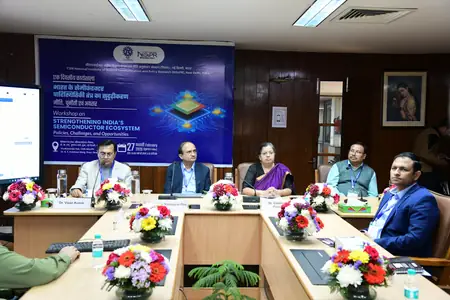
At a specialized workshop in New Delhi, Dr. Geeta Vani Raisam, head of CSIR-NIScPR, illuminated the institute’s role in shaping India’s science policy landscape. Formed by merging two legacy institutions, NIScPR is primed to drive evidence-driven policies, deep research, and robust science communication.
Publishing 15 diamond open access journals covering diverse domains like engineering, chemistry, biology, and traditional knowledge, the institute ensures global accessibility to Indian research. Dr. Raisam called for active participation from the scientific fraternity to elevate these platforms, aligning with Atmanirbhar Bharat’s vision of a self-sufficient knowledge ecosystem.
Central to the discussions was a comparative analysis of semiconductor ecosystems in leading nations—US, Taiwan, South Korea, Japan, and China. While drawing lessons, Dr. Raisam emphasized adapting these to India’s distinct socio-economic fabric. ‘Copy-paste won’t work; we must innovate within our realities and match international benchmarks,’ she noted.
The workshop agenda includes unveiling study results, expert deliberations, and drafting a comprehensive white paper. This iterative process underscores the institute’s dedication to continuous policy support amid the dynamic semiconductor industry.
Dr. Raisam’s vision extends self-reliance to intellectual domains, urging scientists to contribute to journals and propagate their impact. As India eyes semiconductor self-sufficiency, such institutions bridge research and real-world application, fostering innovation tailored to national needs.