

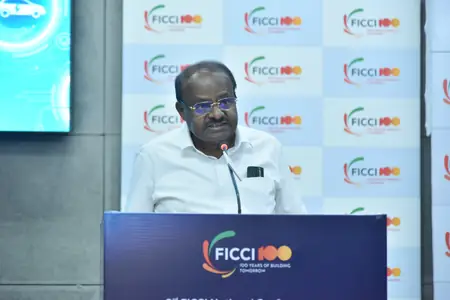
Union Minister H.D. Kumaraswamy envisions India transforming into the global epicenter of electric mobility manufacturing, fueled by decisive policies and industry synergy. At the FICCI National Conference on Electric Vehicles in New Delhi, he rallied stakeholders to seize this opportunity under the ‘Make in India’ banner.
Addressing reporters, Kumaraswamy committed to adopting global best practices for EV adoption. He linked this drive to the ambitious ‘Developed India 2047’ vision, stressing that prioritizing EVs would supercharge local production, localization efforts, and establish India as the go-to source for electric vehicles, advanced batteries, and key components.
The minister spotlighted India’s auto component export boom—from $8 billion a decade ago to $16.9 billion today—signaling the country’s enhanced role in international supply networks and manufacturing prowess.
Keynote speaker Amitabh Kant, ex-NITI Aayog CEO, forecasted a trillion-dollar global EV industry by 2035. With supply chains reshuffling due to geopolitical shifts, he called on India to cement its status as a trusted manufacturing hub. Kant framed electric mobility as a multifaceted boon: environmental, economic, industrial, tech-driven, and geopolitically astute, integral to India’s 2047 aspirations.
Vikram Handa, FICCI Green Mobility Co-Chair, detailed India’s matured ecosystem. Spanning critical minerals processing, battery cells, packs, and vehicles from bikes to heavy trucks, plus charging networks, ‘Green Mobility 2.0’ exemplifies India’s comprehensive strategy and boundless prospects.
This convergence of visionaries signals a pivotal moment. India’s blend of policy resolve, export growth, and value chain mastery positions it to capture a lion’s share of the EV revolution, propelling sustainable growth and global leadership.