

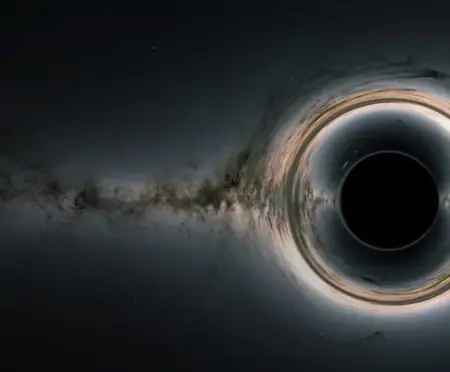
Black holes stand as the ultimate enigmas of modern astrophysics, regions where gravity crushes matter into oblivion and light itself surrenders. Contrary to their name, they aren’t voids but ultra-dense spheres where mass accumulates so intensely that spacetime curves beyond comprehension, forming an inescapable trap.
The telltale sign of a black hole’s presence often comes from its accretion disk—a blazing ring of superheated plasma orbiting the edge. Temperatures soar to extreme levels, unleashing X-ray bursts that betray the hidden predator within. This indirect evidence has been crucial for astronomers hunting these stealthy giants.
Gravitational lensing offers another window into their world. The black hole’s gravitational field acts like a lens, bending and amplifying light from quasars and galaxies positioned behind it. This distortion reveals otherwise undetectable black holes, multiplying images and stretching light paths in surreal displays captured by telescopes worldwide.
NASA describes the event horizon as the final frontier: an invisible boundary encircling infinite density at the singularity. Beyond it, all paths lead inward. Sagittarius A* dominates the Milky Way’s core, boasting 4 million solar masses. Proximity spells doom through spaghettification, where gravitational gradients elongate bodies into thin filaments before annihilation.
The spectrum spans from diminutive black holes at 3.8 solar masses to TON 618, the colossal king at 660 billion solar masses. Rapid rotation defines them, with some spinning faster than a thousand times per second. Far from science fiction portals or cosmic sweepers, they emerge from stellar collapses post-supernova. Their subtle gravitational tugs mimic stars from distance, fueling endless research into the universe’s fundamental laws.