

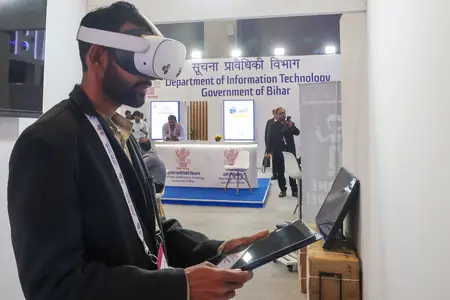
India’s rural heartland is witnessing a technological renaissance driven by artificial intelligence, with Bihar leading the charge through strategic partnerships and innovative tools. The ‘AI for All’ strategy underscores AI’s role in equitable development, echoing NITI Aayog’s visionary 2018 blueprint.
Bihar’s spotlight moment came at the 2026 India AI Impact Summit, where MoUs for AI excellence centers promised breakthroughs in farming, health, learning, and administration. This aligns with national efforts to extend high-tech solutions to underserved areas.
Take ‘Sabhasar’, the AI marvel from Panchayati Raj Ministry: it auto-generates multilingual minutes from panchayat recordings, operational in 14 languages via Bhashini. Adopted by 92,000+ panchayats by late 2025, it’s slashing paperwork and sharpening focus on SDGs.
e-GramSwaraj streamlines finances for 250,000+ panchayats, while Gram Manchitra’s geospatial mapping revolutionizes asset tracking and crisis response. AI Kosh, the national data hub, offers 7,500 datasets and 273 models, drawing 6.9 million visits and 5,000 downloads by February 2026.
MGNREGA’s Bhuprahari app uses AI for live asset oversight, set for nationwide expansion to boost accountability. Farmers gain from Kisan e-Mitra’s scheme guidance and AI-driven pest alerts via satellite analytics, optimizing irrigation and sowing for higher productivity.
In classrooms, NCERT’s DIKSHA integrates AI for accessible content, empowering disabled learners. Yuva initiative equips students with digital prowess, Bhashini democratizes services in 36 languages with 350+ models downloaded 1 million times. BharatGen handles text, speech, and images in 22 languages; Adi Vani preserves tribal dialects; Pancham fosters official chats.
By skilling youth and filling service voids, AI is curbing urban exodus and fostering atmanirbhar villages, heralding a new era of rural empowerment.