

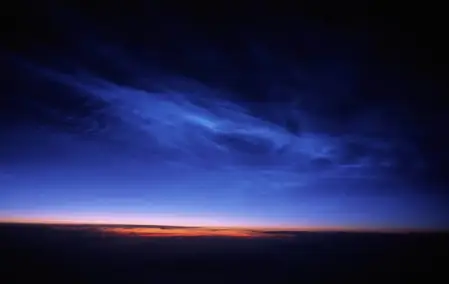
Picture the summer sky at midnight in polar regions: a canvas of deep blue pierced by silvery, wave-like clouds that pulse with light. These are noctilucent clouds, elusive wonders that have puzzled observers for over a century. Their name, derived from Latin for ‘night-shining,’ perfectly captures their ability to illuminate the dark.
High above the troposphere, in the frigid mesosphere roughly 50 to 86 kilometers up, minuscule ice crystals form around meteor dust or atmospheric particles. When the sun dips below the horizon, these crystals reflect its direct light, creating a radiant display invisible during daylight. The result? A rainbow-hued veil that dances across the horizon, best seen from latitudes above 50 degrees.
NASA’s pioneering AIM mission transformed our knowledge starting in 2007. Capturing the first full Northern Hemisphere view on June 11, it showed clouds covering immense expanses with resolutions down to 5 kilometers. Observations confirmed their daily rhythm, shape-shifting over hours and days, with brightness varying on 3-kilometer scales.
Recent intensifications worry experts. Brighter apparitions at lower latitudes correlate with increased methane levels, which break down into water vapor essential for ice crystal growth. This trend, accelerating since the 1990s, underscores methane’s role in altering upper atmospheric conditions amid global warming.
From historical sketches by early 19th-century astronomers to modern satellite imagery, noctilucent clouds bridge past fascination and future warnings. They invite us to gaze upward, pondering the delicate balance of our planet’s protective veil.