

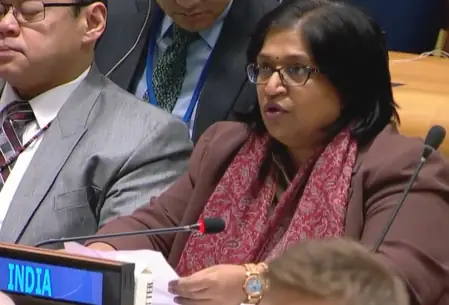
United Nations, February 21: India delivered a scathing critique of plans to introduce a third tier of seats in the UN Security Council, insisting that genuine progress hinges on expanding permanent memberships first.
During Friday’s IGN session, Deputy Permanent Representative Yojana Patel warned that such a category—offering extended terms without permanence—would trap the UN in a crisis of relevance for generations. She accused proponents of using it to stall meaningful change.
This ‘fixed regional seats’ concept comes courtesy of the Uniting for Consensus (UfC) bloc, a coalition including Italy and Pakistan, notorious for obstructing negotiations through endless procedural games.
‘It’s a deliberate half-measure that undermines the UN’s credibility,’ Patel declared, highlighting near-universal agreement on the need for swift reform, save for a handful of blockers.
Japan’s Kazuyuki Yamazaki, representing G4 nations (India, Japan, Germany, Brazil), drove the point home: these seats mimic temporary ones without guaranteed continuity, failing to fix deep-seated inequities.
G4 pushes for growth in both seat types, with cross-support for permanent bids, dismissing the third category as ignoring the majority’s clear demands.
L.69, a 42-nation developing world group featuring India, piled on via Saint Lucia’s Menissa Rambally. She rejected hybrid models as insincere, noting the Global South’s decades-long wait demands nothing less than structural overhaul.
Patel shot down veto extension to these seats as another obfuscation tactic, stressing that only permanent and non-permanent expansions deliver justice.
Without permanent growth, any package remains flawed and dismissive of reform advocates. She assured that operational tweaks could handle a bigger, more representative Council.
Underrepresentation of key regions like Asia-Pacific, Africa, and Latin America-Caribbean in permanent seats is a glaring flaw no partial fix can ignore.
India’s bold intervention signals rising impatience with foot-dragging, as global powers realign and demand a Council fit for the 21st century.