

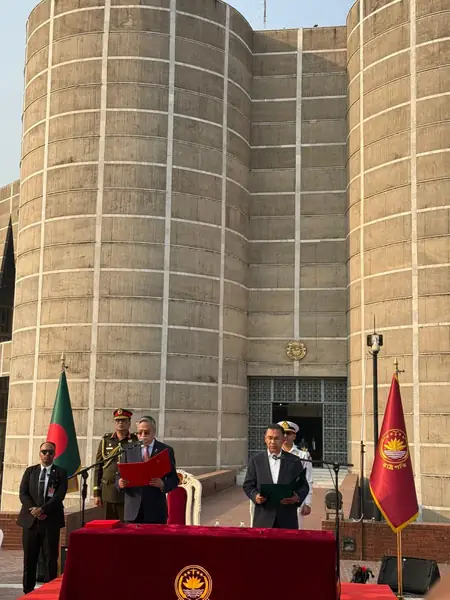
In a significant political shift, Tarik Rahman, the influential chairman of the Bangladesh Nationalist Party (BNP), was sworn in as Prime Minister of Bangladesh on Tuesday. The event ends years of female primacy in the PM’s office, ushering in a new era under BNP’s stewardship.
President Mohammed Shahabuddin officiated the oath-taking at the National Parliament’s South Plaza at approximately 4:15 PM. Rahman wasted no time, inducting a massive 49-member team: 25 senior ministers and 24 junior ministers, reflecting the party’s intent to represent diverse factions.
Standout picks include Dr. Khalilur Rahman helming Foreign Affairs, Shama Obaid supporting as Foreign State Minister, Amir Khasru Mahmud overseeing Finance and Planning, Salauddin Ahmed on Home Affairs, Abdul Awal Mintu for Environment and Forests, and Khandaker Abdul Muktadir managing Commerce.
The ministers’ roster boasts heavyweights like Mirza Fakhrul Islam Alamgir, Salauddin Ahmed, Iqbal Hasan Mahmud Tuku, Hafizuddin Ahmed Bir Bikram, Abu Zafar MD Jahid Hossain, Abdul Awal Mintu, Kazi Shah Moefizul Hossain Kaikobad, Mizanur Rahman Minu, Nitai Roy Chowdhury, Khandaker Abdul Muktadir, Ariful Haq Chowdhury, Zaheer Uddin Swapn, Afroza Khanam Rita, MD Shahid Uddin Chowdhury Ani, Asadul Habib Dulu, MD Asaduzzaman, Zakaria Tahir, Dipen Dewan, ANM Ehsanul Haq Milan, Sardar MD Sakawat Hossain, Fakir Mahbub Anam, Sheikh Robiul Alam, Mohammad Amin Ur Rashid, and Khalilur Rahman.
The state ministers include M Rashiduzzaman Millat, Anindya Islam Amit, MD Shariful Alam, Shama Obaid Islam, Sultan Salauddin Tuku, Barrister Kaiser Kamal, Farhad Hossain Azad, technocrat MD Aminul Haq, Mir Mohammad Helal Uddin, Habib ur Rashid, MD Rajib Ahsan, MD Abdul Bari, Mir Shah-e-Alam, Junaid Saki, Ishraq Hossain, Farzana Sharmin, Sheikh Faridul Islam, Nurul Haq Nur, Yaser Khan Chowdhury, M Iqbal Hossain, MA Muhith, Ahmad Sohail Manzoor, Bobby Hajjaj, and Ali Nawaz Mahmud Khayyam.
As Bangladesh navigates post-election dynamics, this cabinet is poised to tackle inflation, security concerns, and international partnerships. Rahman’s administration promises stability and growth, with early focus on inclusive policies and rapid reforms.