

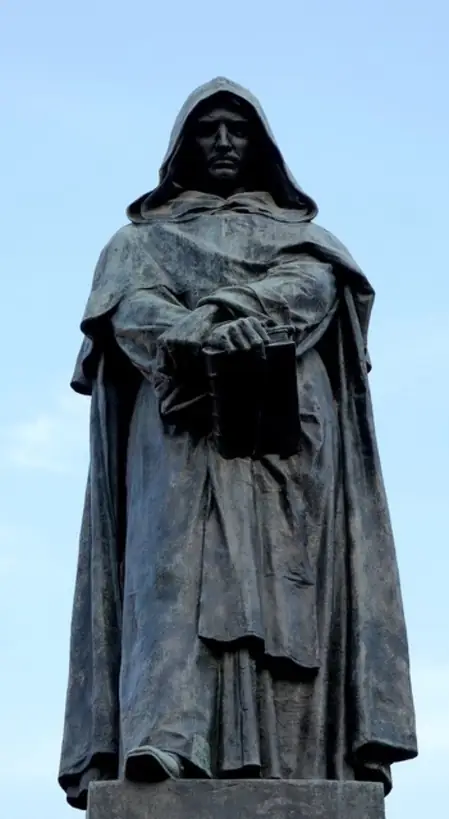
Power has always trembled before bold ideas that threaten the status quo. Few embody this clash better than Giordano Bruno, the 16th-century thinker whose cosmic visions cost him his life. Hailing from Nola, Italy, in 1548, Bruno joined the Dominicans young, diving deep into scripture and philosophy. Yet, his mind rebelled against orthodoxy early on.
Copernicus’s revolutionary sun-centered universe captivated him. Bruno expanded it dramatically: an endless cosmos filled with stars that could anchor their own worlds, possibly inhabited by extraterrestrial beings. This flew in the face of Ptolemaic and biblical models insisting on a bounded universe with Earth at its core. Bruno’s God was no distant tyrant but the vital force permeating all existence, discoverable through logic alone.
Such views ignited fury in the Church. Snatched by the Inquisition in 1592, Bruno faced relentless interrogation in Venice and Rome. For seven grueling years, inquisitors demanded repentance. His unyielding stance led to the ultimate punishment: alive on the pyre in Campo de’ Fiori. Flames consumed him on February 17, 1600, but not his ideas.
Centuries later, Bruno is hailed as a pioneer of modern cosmology and free expression. His monument, unveiled in 1889 at the execution site, draws crowds who reflect on how far we’ve come—and how vigilance against thought control remains vital. Bruno’s story is a stark warning: innovation often burns brightest when opposed.