

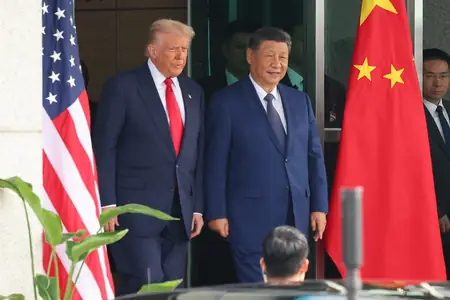
In a major diplomatic reveal, U.S. President Donald Trump announced his intention to travel to China in April 2026 for high-stakes talks with Xi Jinping. Speaking to the press in the White House, he also anticipated Xi’s visit to America before year’s end, underscoring mutual commitment to face-to-face engagement.
Trump’s comments were upbeat: “I’m heading to China in April to see President Xi – can’t wait. And he’ll be here by year’s end; that’s going to be great.”
He brushed off concerns over bilateral ties, insisting, “Things with China are solid. President Xi and I get along great.”
No further details emerged on the summit’s venue, schedule, or topics, nor on Xi’s precise U.S. arrival. This builds on their recent marathon phone conversation, detailed by Trump as covering trade dynamics, defense ties, the proposed trip, Taiwan straits, ongoing wars in Europe, Middle East tensions, and joint energy ventures.
Posting on Truth Social, Trump praised the call as thorough and positive, with heavy emphasis on economic exchanges. Key points included China’s ramped-up imports of American oil, natural gas, and farm goods – a lifeline for U.S. exporters facing global headwinds.
Sino-American relations teeter between rivalry and pragmatism. Trade wars linger with tariffs and tech curbs, while Indo-Pacific maneuvers heighten strategic stakes. Still, leader-level summits serve as vital de-escalation mechanisms.
Regionally, India benefits from balancing acts: thawing China relations post-border clashes and deepening U.S. alliances. Asia holds its breath as these superpowers chart paths that could reshape global trade, security, and energy flows.
Trump’s first term saw trade battles escalate, followed by intensified military and tech races. Detractors argue his approach softens on China amid massive deficits, yet personal diplomacy persists to mitigate flashpoints.