

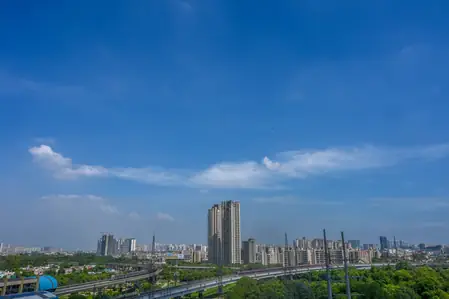
A gusty wind regime has swept through the National Capital Region, delivering much-needed relief to residents battling toxic air. As of February 12, the Air Quality Index (AQI) in key Delhi locales has edged out of the dangerous red zone into orange and yellow territories, signaling moderate rather than severe pollution.
This partial recovery doesn’t mean the air is pristine—far from it—but it’s a step forward amid the winter’s persistent smog challenge. Delhi’s monitoring network reveals Bawana at 259 (orange), with Ashok Vihar (220), Anand Vihar (218), and Dr. Karni Singh Shooting Range (202) following suit. Lighter readings include Alipur (181), Burari Crossing (169), Chandni Chowk (162), CRRI Mathura Road (171), DTU area (169), and Aya Nagar (160), all categorized as yellow to orange.
Across the border in Noida, air quality is similarly uplifting: Sector-125 (190), Sector-62 (170), Sector-1 (190), and Sector-116 (175) reflect moderate conditions. Ghaziabad’s Indirapuram (225) and Vasundhara (230) remain in orange, but Sanjay Nagar’s 139 offers a brighter spot in yellow.
Weather patterns are evolving favorably, per IMD predictions. Temperatures will nudge up, with February 12 seeing 26°C max/12°C min, 27/12 on the 13th, and 28/13 on the 14th. Shallow fog might appear mornings, yet no warnings issued.
Meteorologists and environmentalists credit the winds for scattering fine particulates, but warn of vulnerability. Reduced velocities could trap pollutants again, emphasizing the need for long-term strategies like stricter industrial norms and expanded public transport to safeguard public health.