



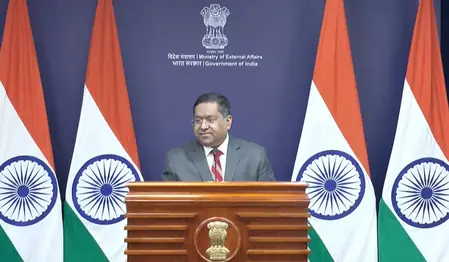
India’s foreign ministry has placed energy security at the pinnacle of national priorities, vowing to adapt sourcing strategies to global realities. Spokesperson Randhir Jaiswal, during Thursday’s briefing in New Delhi, outlined how the government navigates market fluctuations and international dynamics to safeguard supplies for 1.4 billion citizens.
‘Public statements have repeatedly underscored this priority,’ Jaiswal remarked. ‘Our strategy hinges on diversifying energy sources objectively, informing every decision now and in the future.’
Spotlight fell on Venezuela relations, with Jaiswal recalling decades of collaboration in crude oil, trade, and investments. Imports flowed steadily until U.S. sanctions intervened in 2020, prompting a hiatus. Efforts resumed last year but were curtailed anew by renewed restrictions. Despite challenges, Indian firms like ONGC Videsh have partnered with PDVSA since 2008, embedding presence in the South American nation.
India remains pragmatic: ‘We’re prepared to assess commercial feasibility from Venezuela or elsewhere,’ he affirmed, aligning with broader energy resilience goals.
The briefing echoed recent high-level outreach. Last week, PM Modi fielded a call from Delcy Rodriguez, fostering visions of enhanced partnership. Modi’s X update captured the synergy: shared commitment to propel India-Venezuela ties to new heights across multiple domains.
PMO insights revealed consensus on expanding collaboration in energy, trade, digital tech, healthcare, farming, and cultural exchanges. This dialogue reinforces India’s multi-vector energy diplomacy, blending historical bonds with forward-looking opportunism. As tensions simmer worldwide, such maneuvers fortify the subcontinent’s energy fortress.