

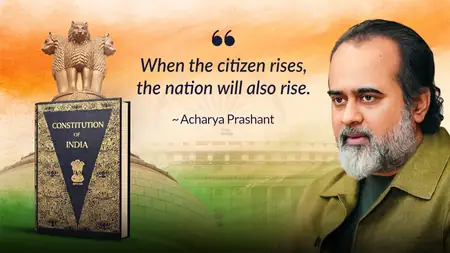
In a thought-provoking address ahead of India’s 77th Republic Day, spiritual teacher Acharya Prashant redefined the concept of a republic, insisting that external structures mean little without internal liberation. Speaking in New Delhi, he urged citizens to confront the tyranny within before celebrating outer sovereignty.
‘A republic – gantantra – signifies rule by the people, free from monarchical or traditional dominance. People govern themselves alongside democracy,’ Prashant elaborated. Yet, he pivoted to the core challenge: ‘External kings are gone, but internal rulers persist – our base urges, blind faiths, and ego.’
This inner despot, fueled by ignorance, proves deadlier than invaders, he argued, as it self-perpetuates exploitation.
Delving into the Constitution’s Preamble, Prashant described it as its spiritual core. ‘We, the people… solemnly resolve… adopt and give to ourselves this Constitution.’ This language embodies self-sovereignty, deliberate commitment, and self-dedication to chosen principles.
Using the Gita’s Kurukshetra as metaphor, he noted, ‘Krishna equips Arjuna with inner wisdom amid external battle, proving inner freedom shields against outer bondage.’
Prashant challenged the feasibility of constitutional values without personal transformation. ‘Ego recoils from socialism, secularism, fraternity – ideals demanding inner purity. High-sounding sovereignty and democracy falter without self-illumination.’
Democracy risks becoming herd mentality sans vigilant citizens. Socialism devolves into envy-fueled comparison. Sectarian pride mocks secularism. Justice, liberty, equality, brotherhood remain ornamental without inner light infusing them with life.
To youth, he declared, ‘Nation means its people – we are the gan. Raise yourselves high.’ Greatness is a collective duty of the masses, not relics of history or leaders.
Spirituality, he demystified, is straightforward: ‘Witness yourself. Deny refuge to flaws, vices, chains.’ As Indians internalize this, the nation surges to global exemplar status, embodying universal kinship.
India’s nationalism, he contrasted, promotes welfare sans enmity, distinct from violent nationalisms, aligned with constitutional humanism.
In summation, ‘Ideals depend on humans. Constitution calls for superior, robust, awakened beings. Exceling Indians simplify national excellence.’